
Seaspan Invests $1.5M In Robotics To Automate Shipbuilding Blast & Paint Operations
 - 
 - 
 - 
 - 


 - 


Maritime Medical Examination in Georgia Without a Queue. Special Conditions for Seafarers from Ukraine, Russia and Belarus

25 years of experience, P&I Club certificates, yellow fever vaccination, special offers for seafarers from other countries: transfer service, accommodation search, discounts on certificates in partner training centers, employment assistance through Georgian crewing companies.

From STCW to Smart Ships: Where Seafarers Train in Greece – Part 5
Greece is one of the key countries in the global maritime industry, home to a large concentration of shipowners, crewing companies, and training centers for seafarers.
That's why we've dedicated a separate feature to Greek maritime training centers—places where seafarers can complete their training, renew certificates, and gain new knowledge, including in the areas of smart ships and emerging technologies.

When the Storm is Inside You: the Problem that is not Talked About - Suicidal Tendencies at Sea.
The seafarer's profession is one of the most stressful, with high isolation and harsh working conditions, and can lead to increased stress levels, depression and, as a consequence, suicidal risks.
What leads a person to suicidal thoughts and what should you do if you have suicidal thoughts?
How Your Facial Expression in a CV Photo Affects Perceived Competence

Psychologists, HR professionals, and nonverbal communication researchers have long studied how facial expressions in photos shape the perception of a person as competent, trustworthy, and right for the job.

The key finding is clear: people form first impressions of a candidate in a fraction of a second, and facial expression has a major impact on how professional they appear.


Seaspan Invests $1.5M In Robotics To Automate Shipbuilding Blast & Paint Operations

26.02.2026
322
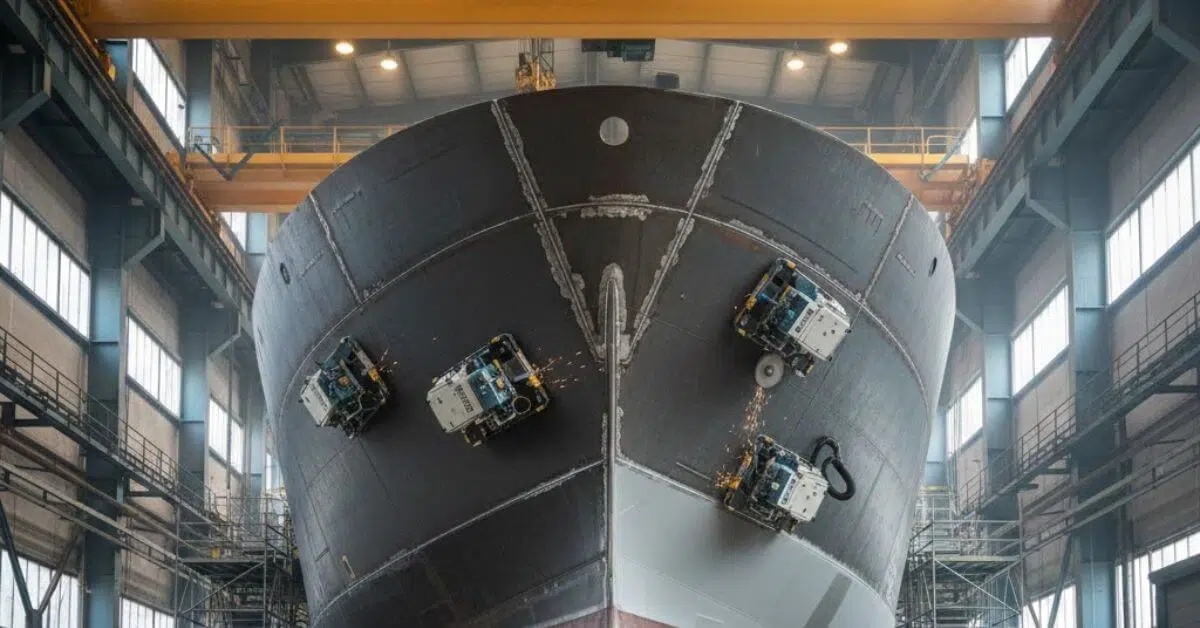
 
Vancouver-based Seaspan Shipyards has awarded a $1.5 million contract to Alberta’s Confined Space Robotics (CSR) to develop semiautonomous robotic systems for blast and paint operations across its ship and submarine programmes.
 
The robotic platforms will be equipped with specialised tools, including needle scalers, laser ablation systems, grinders, grit blasters and spray-coating equipment.
 
Custom-developed software will manage path planning and operational control, enabling the systems to function inside confined and high-risk spaces where workers are typically exposed to toxic fumes, particulates and repetitive strain.
 
Blast and paint work is used in new shipbuilding as well as in complex submarine projects, ship repair and overhaul.
 
Seaspan said the initiative is intended to make these operations safer, more efficient and higher quality across its business.
 
By assigning repetitive surface preparation and coating tasks to robotic systems, the company aims to reduce worker exposure to hazardous environments and long-term strain injuries while improving consistency in application.
 
The equipment will be mounted on mobility platforms designed for manual manoeuvring and integrated with software that controls movement and user operations.
 
Source: www.seaspan.com
 
 
Share:


Confirm
Cancel

Confirm
Cancel


Yes
No