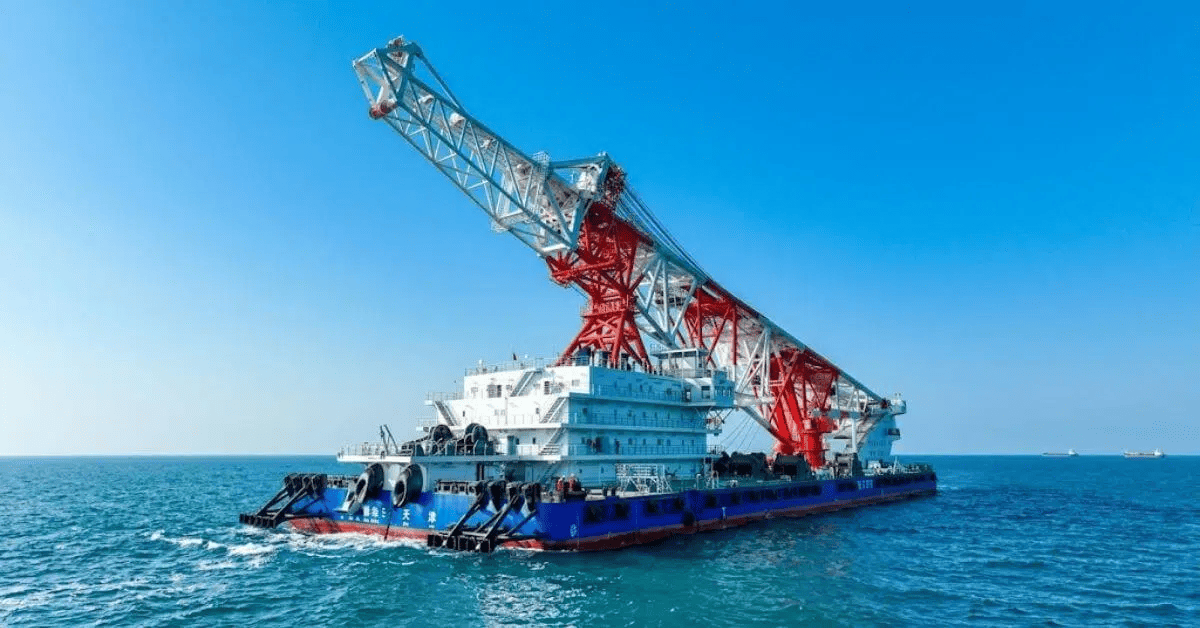
The vessel CRCC Bridge Piling No 1, the largest of its kind globally, departed Lyusi Port in Nantong, Jiangsu province, on Sunday, bound for Brazil's All Saints Bay (Baia de Todos os Santos) to construct Latin America's largest cable-stayed cross-sea bridge.
The vessel will support construction of the Salvador-Itaparica Bridge, which spans Brazil's largest bay and requires pile foundation works in waters 64 meters deep.
"Complex ocean geology, strong currents and variable wave conditions have long made the site a major engineering challenge," said Song Jian, the vessel's construction director at China Railway Construction Bridge Engineering Bureau Group (CRBG).
Conventional global pile-driving vessels typically feature 80-meter pile frames, hundred-ton lifting capacity and decimeter-level positioning accuracy, with limited resistance to strong offshore winds — leaving them unfit for the depth and conditions in All Saints Bay.
The 130.5-meter CRCC Bridge Piling No 1 has a 156-meter pile frame and a 700-ton lifting capacity, with a maximum operational water depth of 70 meters, making it the most capable vessel of its kind in the world.
At its core is the world's largest luffing hydraulic cylinder, entirely domestically designed and manufactured.
"Technically, the vessel achieves two global firsts," Song said. "We are the first to apply an integrated dynamic positioning and anchor-mooring positioning system on a large pile-driving vessel. Combined with China's domestically developed BeiDou high-precision satellite navigation system, it delivers centimeter-level pile-driving accuracy."
The vessel is also the first to equip a pile-driving vessel with a closed-loop main cylinder hydraulic system, which converts potential energy generated when the pile frame lowers or tilts into recyclable electricity, with an energy recovery rate of 40 percent, Song said.
Fitted with a selective catalytic reduction (SCR) exhaust treatment system, the vessel meets the strictest IMO (International Maritime Organization) Tier III emission standards and can operate in all global emission control zones.
Source: chinadaily