

IQUA Robotics Validates AUV Use For Ship Hull Inspection Without Human Divers
02.04.2026
332
IQUA Robotics has completed proof-of-concept tests showing that Autonomous Underwater Vehicles (AUVs) can be used for ship hull inspections without relying on divers or tethered robots.
The work focused on improving current inspection methods, which usually depend on divers or remotely operated vehicles (ROVs).
These methods require constant human control and can be difficult to use in some conditions. In this project, the Sparus II AUV was used as a fully autonomous system that can scan the ship hull without direct operator control.
During the trials, the system demonstrated several important capabilities. The vehicle used multibeam sonar to detect the shape of the hull in real time and adjust its position to maintain a constant distance.
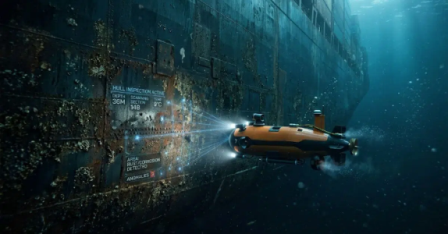
It followed a “lawnmower” navigation pattern to cover the entire inspection area in a structured way and collect images of the hull.
Safety systems were also tested, allowing the vehicle to move away automatically to a safe area if a failure occurs, reducing the risk of getting trapped under the vessel.
The tests were carried out in real port conditions. Data was collected from four different vessels, including fishing, research, and defense ships.
The system was able to generate 3D reconstructions of the hull with centimetric resolution. This makes it possible to identify corrosion, marine growth (biofouling), and damage to paint.
Source: iquarobotics
Share:


